Let me confess something. I have a terrible habit of over EQ'ing.
The thing is, I'm not even sure it's necessarily a wrong thing. I mean, it sounds good in the end so I'm all good there.
But I can't help but wonder if maybe I'm screwing with the phase too much.
If you're in the same boat I guess you shouldn't be too worried either, but if you're slapping four or five EQ plug-ins on a track maybe you should revisit your first one.
See if you can get a good sound from your first EQ before moving on.
Guidelines to Live By
There are three guidelines you can live by that'll improve your EQ skills immensely.
In that order.
Filter out the stuff you don't
need. Not just the low-end but the high-end as well.
Cut weird resonances and overtones that cloud the character of the sound. Snare rings,
muddiness, boxy drums, hissy guitar etc.
Boost what's needed. Add extra fundamentals and mids to keyboards to cut through. Add presence to vocals. Add air to overheads for example.
In a dense mix, you might need to filter and cut more. In a sparse mix, you'll need to add extra thickness or presence to something to make it sparkle. Every mix is different.
Is It Really EQ You're Looking For?
Notice that boosting is last on the list above.
It's not because boosting is bad. Sometimes you'll never get the sound you're looking for unless you boost certain frequencies, phase shift and all.
But don't boost if a volume boost is all you need.
And sometimes, you can actually use subtractive EQ and boosts at the same time!
Let me explain:
You know how you've heard that you should cut rather than boost right?
USE SUBTRACTIVE EQ! IT'S BETTER FOR THE SOUL!
Well, you might also think your instruments always sound weaker afterward if
you only cut the signal.
Not to worry my friend, that's absolutely understandable.
Better yet, there are a couple things you can do to make your instruments cut through while still feeling good about yourself.
Solution #1 - Boost the Output
This is normal gain staging. If you're reducing a bunch of frequencies you're cutting a whole lotta amplitude out of the signal.
And another name for amplitude is
volume.
So there's no wonder your tracks sound weaker in the mix. You've turned down the volume all the way down and our dumb ears think that everything that's louder is better and here we are making everything quieter like idiots.
So instead of pushing the fader as far as it goes on your mixer, just turn up the output gain of your EQ instead.
You've
reduced the volume of the signal by EQ'ing a bunch of it out. Now bring the track back to its original volume by boosting the output of the EQ instead of cranking up the volume of the fader.
Trust me, it's simpler. Especially if you already have a good level balance before you started
EQ'ing.
You did balance the faders before you started EQ'ing didn't you?
But with all
those cuts you still might want to accent some frequencies with some boosts.
That leads us to...
Solution #2 - Boost Inside Your Cuts
Say your keyboards and guitars are clashing in the mids. You want to make room for both instruments so you start by cutting the mids in the keys to make room for the guitars.
But now the keyboards sound weak but you don't want to increase the gain of the overall EQ because they'll just start clashing with the guitars again.
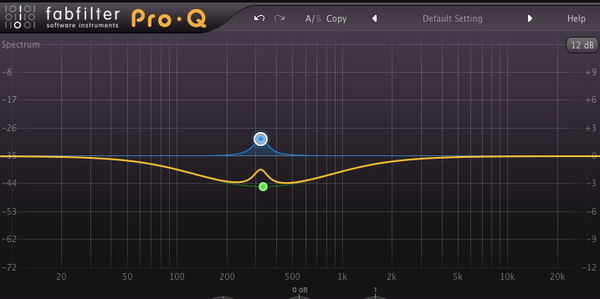
So what you can do then is add another bell boost inside the cuts to accent the fundamental frequency of the keyboards, preferably one that doesn't sit right on top of the guitars.
So a good way to do it is to do a broad cut through the mids and then
adding a narrower boost to help the keyboards cut through.
Check out the image below for an example.