Let's wrap up this three-part series with some tips on
toms, overheads and bus EQ.
Toms are simple to EQ. You want to reduce boxiness, increase thump and add attack.
Here's what you do:
Cut the Mids - Wide boosts work really well when you just want to completely get rid of that boxy
sound. Just make sure you leave some left so that it doesn't sound hollow.
Add the Lows - Since every tom has a different diameter, their fullness frequencies differ. Floor toms sound full when boosted at lower frequencies, at 80 - 100 Hz for instance, while smaller toms need boosting at closer to 250 Hz. Sweep around until you find the sweet spot to boost.
Sprinkle with Highs - Similarly, add the attack by boosting from between 5 kHz and 7 kHz, depending on the size of the tom.
Overheads
I like taking a master EQ approach when it comes to overheads. Bus both of your overheads together so that you only need one
stereo EQ.
Then you can approach it one of two ways:
Master EQ - Do slight cuts and boost to create the best sounding overall EQ. This means adding slight low-end boost to bring out the kick drum, reducing some of the overall boxiness and adding presence and air in the upper-mids and high frequencies.
This will give the overheads a great overall drum sound. With this method you can start your drum mix with the overhead sound. Then you can add the other drums to the overheads to enhance an already great sound from the drum-kit.
Cymbals only - If you only want to use the overheads for the sound from the cymbals,
use a high-pass filter to cut out everything up to about 500 Hz.
Sounds drastic, but if the other microphones sound great and you can't get a good overall overhead sound going, this method can be a great alternative.
Overall EQ with bussing
Finally, you
can do the same overall EQ as I explained with the overheads, but this time with all of the drums. Simply buss them all together to one stereo group and add a stereo EQ. Then use that to sculpt a perfect master EQ for your drums.
Use this guide the next time you're EQ'ing your drums. I guarantee that these frequency areas will help you solve many of your drum EQ problems.
How Will You Keep Learning to EQ?
I remember how I learned to EQ.
It was in a dimly lit rock venue where I could hardly see what I was doing. I twiddled the knobs back and forth but never really knew what I was doing. Sure, the sound of the mix changed. Sometimes for the
better, most of the time for the worse.
But it wasn't until I spent hours behind that mixing board and studied what each frequency sounded like and what it does to the mix that I finally got it:
EQ is the most important mixing processor to create separation between the instruments in your mixes.
You might be having trouble
getting cleaner mixes, or making all the rock guitar tracks stand out in a dense mix. Maybe your vocal sounds like it's muffled under the other instruments that already sound like they're under a blanket.
If that's the case, that's not good. You want to get those instruments jumping out of the speakers, with the vocal leading them like it's the leader of the Avengers.
If you like help with
that, guess what? I've got just the thing.
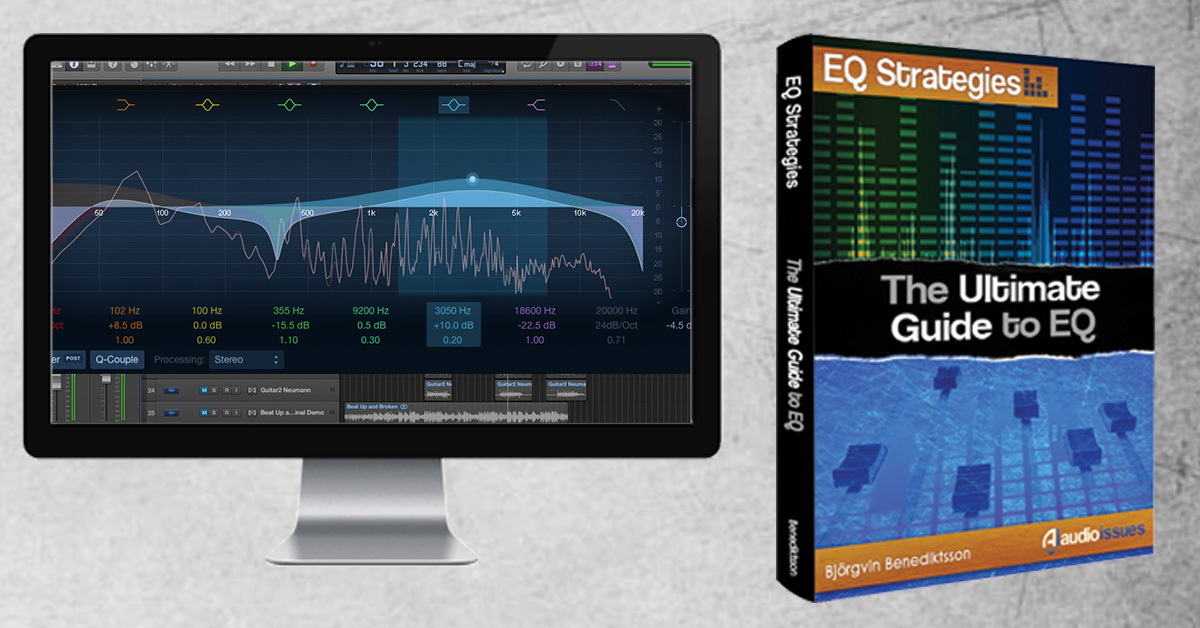
It's called EQ Strategies - The Ultimate Guide to EQ. It's an in-depth course filled with great practical tips on making the best EQ decisions for your mix.
Here’s what a couple engineer had to say about it recently:
“Everything was helpful. I used to fiddle with knobs until it sounded right. Now I can just go directly to the frequencies I need to boost or cut. I also learned more about how to use compression. I am enjoying learning and understanding more about mixing. I play out frequently and have a very good live drum sound. Your EQ Strategies has already helped me improve the sound by helping me
understand compression better and how to use it on drums.” -Jean F Peters
“The book is full of tips that are immediately useful. Like anything you are learning, it takes 'doing' and more 'doing' before you can start to polish your work. But the initial results are immediate and impressive….thanks. The format helped me solidify the basics very
quickly. I sampled a few sessions with the concepts and found an immediate and pronounced improvement.” -Dave Michaels
I want you to be proud when you show people your mixes, knowing that they hear everything loud and clear, without any muddiness in the lows or harshness in the
highs.
But unless you learn how to create separation between the instruments and clarity in your mixes you can't really get that feeling.
So let's get you started making clean and powerful mixes you can be proud to show to everyone.