If you want to do audio work professionally,
sooner or later you're going to have to answer the crucial question:
How much should I charge?
Pricing yourself is hard because there are so many different ways to look at it.
- Do you charge hourly?
- Do you charge a flat rate per project?
- Do you charge
hourly for certain things but a flat rate for others?
Regardless of how you answer those questions, there is one mistake amateurs make when they're thinking about their rates.
They don't consider the entire scope of the project.
For instance, if you charge hourly for a single song you might start the timer as soon as the band comes into the studio.
Then you start the timer again when you start mixing the song. This is a terrible way to price your services.
What about all the time you're working for the band when they're not in the studio?
It should also include:
- Revision time
- Communication time, or time spent emailing or texting back and forth
- Any other energy spent serving the client
I don't believe that as an engineer you should limit yourself to charging only for your physical time in the studio. Your price should also include caring about your client and helping them create a great final product.
This doesn't always have to factor into your rate if you feel uncomfortable with that. You can also think about it as
value-added perks of working with you.
For instance, in addition to producing an EP for a local punk band, I used my connections to get them a live show on one of the local radio stations to promote their release show.
Also, because of my entrepreneurship, economics and marketing background, I gave them a crash course in marketing their music online. That's the kind of knowledge I actually charge handsomely for as an online marketing strategist for medium to large businesses (something I do on the side...), but for them, they get it as a perk of working with me.
That's why I advocate quoting flat rates per projects that allow you to estimate the entire scope of the project, additional knowledge,
value and perks included.
That way you can still estimate the number of hours you need to work, in addition to any revision time, mixing time, and communication noise from emailing and communication.
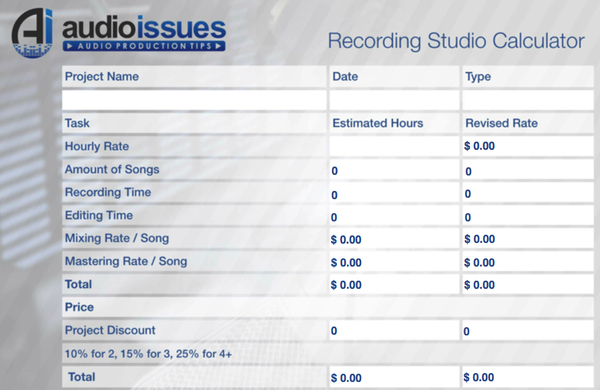
Luckily for you, I created a handy calculator for you that helps you do that. It allows you to estimate your entire recording project, from recording and editing to mixing and mastering.I'm doing some final
touches on the packaging and creating a tutorial video to help you use it, but it'll hit your inbox tomorrow!