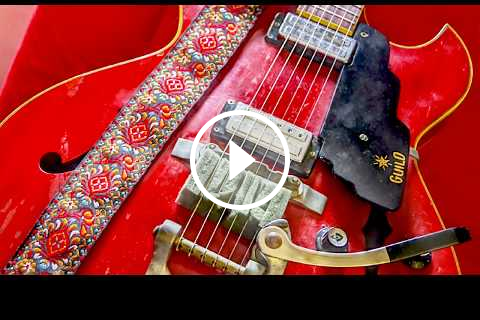
When I was in my teenage rock band(this is a rite of passage for any guitarist I think), I dreamed of making my guitar sound larger than life.
You know that thick and creamy sound you hear on your favorite rock records?
That's what I was chasing.
I've talked about this quest of mine before. I
just thought that if I could get the exact set up right, then I'd sound exactly like my heroes!
So...I spent an endless amount of time researching the amps, guitars and pedals of my guitar heroes.
I wanted all of their equipment: their Mesa Boogies, their ESP Explorers, and their Big Muffs. In addition to all the other cool things they were using on those
records, of course.
The fact is that most of those massive guitar sounds came from the amp, but that's not the only piece of the puzzle.
It's not just the equipment, you still need to know how to record it well.
Make it Sound Right in the Room
If you want to record a great guitar sound, it's not just about cranking
up the amp in the room. Sure, a loud-as-Clapton tube amp is gonna sound pretty amazing like that but if you're not thinking about how it sounds in the room then you might only get half of the awesomeness that's coming out of that amp.
Bare walls, reflections, and positioning of the amp is still an important factor. Move your amp around, put some baffles up and make sure that you pick up every single nuance of the sound.
But even a perfectly placed amplifier won't help you if you're lacking the most crucial ingredient of all.
The Feeling in Your Fingers
Eric Clapton is pretty famously known for his Stratocaster. Many of you may know that he also used a Les Paul and an SG during his Cream years.
Sure, they sound very different but when Clapton plays them, those
solos sound like Clapton.
Why?
Because his sound is in his fingers.
I know what you're thinking,
"...well I've heard other guitarists play a Clapton solo note for note and it sounded exactly the same!"
Exactly!
Because the sound is in the fingers. If you practice to the point where your touch and feel sounds like Clapton, congratulations. You've stopped relying on amps, equipment and guitars to make you a better player. You've become one through practice.
Ultimately, that's what a good guitar sound comes down to. A well-played performance full of touch and emotion.
And that's how you make
that guitar mix sound amazing. It's not the equipment, it's not the pedals, it's the player.
Don't Destroy the Sound Through Poor Recording
So when you have an amazing player in the studio, you have to make sure your chops are as good as their tone. If their sound is in their fingers, your sound is in your ears. How you mic up the guitar and produce the sound during the mix is key to translating that awesome
performance.
That's where Mark Marshall's Producing & Recording Electric Guitar comes in. If you've been struggling to reproduce the tones from a guitar amp to sound just as good after you've recorded them, then you'll love this course.
Watch Mark's tutorial overview below
and then grab the tutorial series here.