One of my least favorite memories from recording school was when I became the stereotype that pro engineers would later talk shit about.
I was an over-zealous beginner that thought More was Better. So naturally, when you're recording guitar, you have to use as many mics as
possible on the amp to get the best sound right?
So, so wrong...
Here's how fucking stupid I was:
- Mic #1 - On the cone in the center. So far so good. I should've stopped there.
- Mic #2 - As an ambient mic in the room. Because I needed all that extra space in the mix or whatever.
Idiot.
- Mic #3 - Miking the back of the cab to get the thick bass coming out of the back of the speaker. Don't even get me started on phase issues, and I even used a goddamn D112 kick drum mic because I thought it would have a better bass response.
If I could go back in time I'd slap myself in the face and throw all that unnecessary gear through the glass in a blind
rage!
The reason I'm bringing all these painful memories back is that my friend Jordan Valeriote has almost the exact same story. In his case, it wasn't an electric guitar, but a drum kit.
In the first video in his 3-video workshop on getting great sounding tracks at the source, he shared his story of how he overmiked a drum kit. Jordan, much like myself, was an overzealous beginner that thought he
needed to use all the mics in the studio to get a good drum sound.
But then when he got the mix back, the mixing engineer told him he had muted a bunch of the mics he used because they weren't adding anything to the sound.
It's not more microphones that make your tracks sound better. Things aren't that complicated. You can certainly make it super complicated because you think that's how it should be
done, but it's just not true.
Less is More and Simpler is Better.
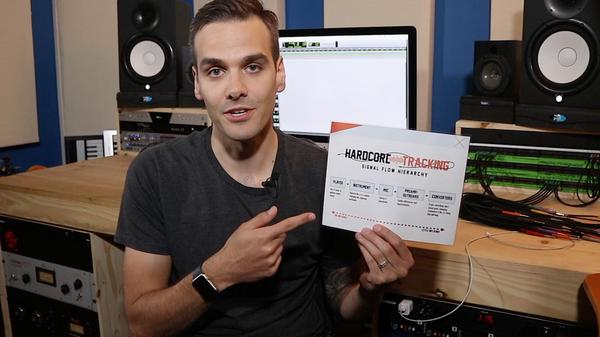
What Jordan teaches you in his first video is how you can identify the most important thing in your signal chain.
Newsflash: It's not More Gear, as much as the gear companies want to persuade you otherwise. It's actually the opposite.
And with his
Signal Chain Hierarchy PDF you'll learn to create a framework to get better recordings every time.