Today I was talking to my friend Chris Graham, of Chris Graham Mastering and The Six Figure Home Studio Podcast, and he reminded me of something I told him a while ago.
He said that it had really made an impact on his thought process.
What is it?
"When pondering a problem, the simplest solution is usually the best."
Simple, ironically
enough...
Sometimes I lose sight of this, so it's good to have friends that pull you back to reality.
It's the type of philosophy I live by when I'm mixing.
You've probably heard it before, but
using groups and busses is my #1 recommendation when it comes to simplifying your mix. It helps you organize your tracks better, it cuts your track count down and it simply makes for an easier mixing experience.
If you start your session off by grouping
everything together and making it simpler, you'll be surprised at how much easier mixing will become.
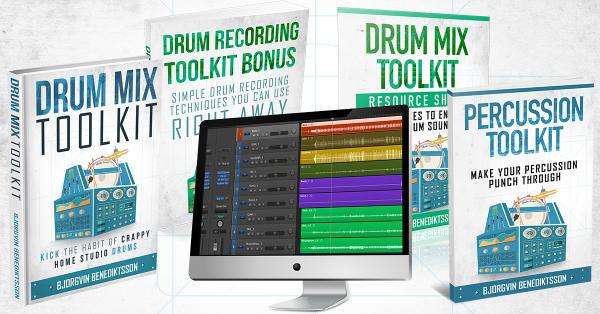
Using subgroups, send effects, filters and reverb on drums is something I talk extensively about in the Drum Mix Toolkit and today is possibly the best time to finally dig into it on your own.
Why?
Because if you buy it before tonight I'm including my free guide, Simple Drum Recording Techniques You Can Use Right Away so you don't only get great drum mixes, but you'll also learn to get killer drum sounds right at the source.
Here's what's included in your free guide:
- How to tune your drums to make them sound as good as possible through your microphones
- How to dampen your drum sounds to make them easier to mix
- How to save a bunch of $$$$ by not wasting it on overpriced Moongels to dampen your drums (there's a cheap children's toy that does the same thing for a fraction of the price)
- How to record the bass drum to get a thick and snappy kick
- What microphones to use to get the most out of your kick and snare
- How to make the most out of any room you record in, whether
you have a real studio or stuck with a small bedroom
- The 3 most common overhead miking techniques and when to use them
- How to get interesting room sounds by experimenting with crazy room mic
placement
- 5 Tips for frustration-free drum recordings
- How to record drums with only one microphone
- 9 Steps to a Greater Drum Mix
- How Your Polarity Switch Can Mean the Difference Between "Thin and Weak" or "Thick and Tight"
- How to Simplify Your Drum Sound to Make Your Mixing More Efficient
- How to Use Bus Processing and Parallel Compression to Glue Your Drum Sound Together
- How to Use Sample Replacement to Save a Shitty Drum Sound From Itself
- How to Use the Secret Weapon of the Transient Designer to Shape Your Drum Sounds Into What You Hear in Your Head
- How to Blend Multiple Reverbs Together in Your Drum MIx, Making the Drums Sound
Larger than Life
- How to Fit the Kick Drum and Bass Guitar Together in the Low End
- How to Use the Volume Faders to Get the Correct Balance From Your Drums (WHAT A NOVEL IDEA?!?!)
- How to Take Full Advantage of the Phase Relationship
Between Your Tracks to Make Every Track Sound Tighter
- 4 Different Ways of Grouping Your Drums for Easy Mixing
- What Processing to Use When You Don't Have Drum Replacement or Transient Designers at Your Disposal
- Where to EQ Drums to
Get Rid of Boxiness, Muddiness, and Harshness
- Why Your EQ is Kind of Like the Jedi's Trusty Lightsaber
- Your 6 Step Process for Using Drum Compression for Tighter Drums
- A Behind the Scenes Look at How the Ratio of Your Compressor
Affects Your Drum Sound
- When to Choose FET, OPTO or VCA Compression Styles
- How to Use Multi-Band Compression for a Tighter, Yet MORE Dynamic Drum Sound
- How to Use Gates to Get a Cleaner Drum Sound
- What to Avoid When Gating the Kick and Snare
- Why You Should Use Analog Summing and Saturation to Add More Warmth and Depth to Your Drums
- Why Fleetwood Mac's "Rumours" is the Reason I Use This One Plug-in on ALL My Mixes
- How to Use Parallel Compression to Add Power to Your Drums
- Specific EQ and Compression Guides for Kick, Snare, Toms and Overheads
- How to Side-Chain the Bass to Get the Kick to Cut Through
- How to Get a Thunderous Tom Sound in Three Steps
- The Difference Between a Drastic and Subtle Overhead EQ (And When to Choose Which)
- Adding Space to Your Drum Mix Without Making Your Drums Sound Distant
- How to Use Two Separate Reverbs on the Snare to Get it to Stand Out
- How to Select the Right Reverb Mode For Your Song
- How to Use Gated Reverbs Without Sounding Like You're an 80's Cover Band
If you're looking to get a killer drum sound, look no further than
my in-depth resource right here.