You already know EQ is your best friend when you’re trying to separate your instruments in the frequency spectrum.
Now, let me ask you:
Do you want EQ to stay a mystery to you, or do you want to master it?
Knowing how to EQ
is the single greatest skill any audio engineer has.
I learned how to EQ in a poorly lit music venue where I could hardly see knobs, let alone know what the frequencies did.
Don't learn like I did, with trial and error and randomly twisting knobs until "something" sounded "just ok..."
It was an exhausting experience that took a lot of frustration to figure
out.
I want your mixes to sound better than that in less time.
So if you've been looking for a great EQ guide to fix those nasty frequencies in your mixes, look no further than EQ Strategies - Your Ultimate Guide to EQ. It's 50% Off for Wacky Wednesday if you use the coupon code EQ50!
To really start getting great mixes you need to start understanding and
trusting your EQ skills, something Brad Hoese accomplished after going through my EQ Strategies - Your Ultimate Guide to EQ training:
"I have been volunteering at my church (always a live environment with limited time to get things "right" during rehearsal
before the actual services begin) and found myself wanting to learn more so I could do better/more efficient work there. I found your 1 hour mix walk through to be well worth the price I paid for the course. It was helpful to see how you eq'd instruments/vocals 1 at a time all the while paying close attention to how each of them fit into the mix. I had learned
how to eq things in isolation and was taught to use the same methodology as you to find offensive/resonant frequencies and cut them. Where you helped me was in the idea of not so much how does it sound on its own, but how does it sound/sit in the mix. Using kick/bass as an example, I could get each of them to sound great on their own but always thought they sounded kind of muddy together. Last week I went in to practice mixing using recorded multi tracks and tried eq'ing space
for each of them and then they seemed to fit together so much better in the mix. And yes, I even used a very low frequency low cut on both (which I had been taught not to do) and thought it cleaned up the sound even further while still retaining nice hit/punch/clarity."
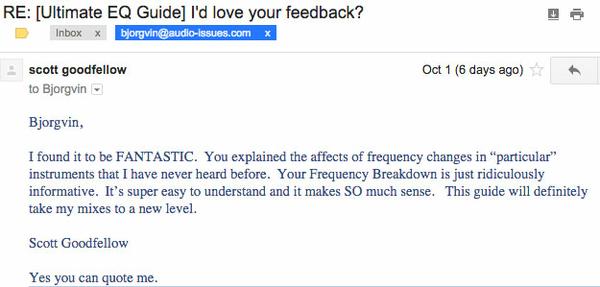
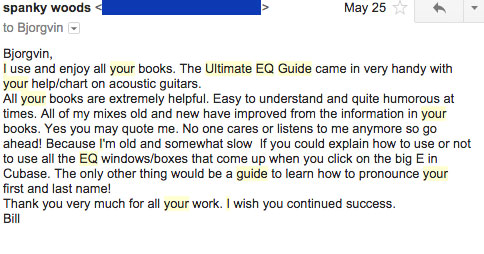
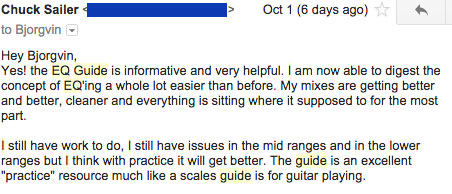
In addition, here are some real emails from satisfied EQ Strategies customers: