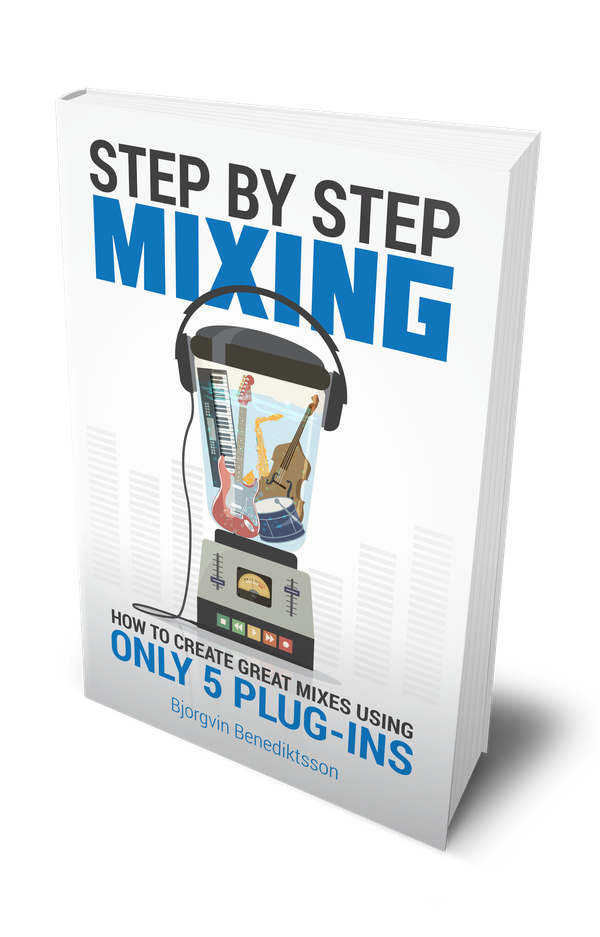
I referenced the final chapter of my best-selling Amazon ebook, Step By Step Mixing: How to Create Great Mixes Using Only 5 Plug-ins when I was making this infographic. To elaborate even further on the translation process I wanted to give you a sneak peek into the part of the chapter where I break it all down for you.
Personally, my mix process is as follows:
Rough Mix
I mix in mono on my Behringer Behritone Mixcube, mostly following the steps I’ve given you in the previous chapters. The Mixcube is a terrible speaker that has no low-end or highs. It has only one driver and sounds pretty terrible. However, if I can make my mix sound halfway decent on this speaker I know I’m getting somewhere.
Multiple Speaker Check
I flip my mix over to my Yamaha HS-5s and do another round of tweaking. This is usually a rebalancing effort on EQ but I also flip my mix out of mono at this point. Now I can hear the stereo spectrum pretty well. If I get a “whoa! That mix really opens up even though it wasn’t sounding bad before” I know I’m on the right track. I’ll spend some time on reverb, delays and other effects.
Then I listen to my mix on my Focal CMS50s that are coupled with a subwoofer. Now I can really hear all the little things in the mix, as well as all the low-end that’s present. Usually, this requires me to tweak the drums, kick, bass and other low-end instruments.
Earbud Translation
Once I feel my mix is done I bounce it and upload it to Dropbox. I take the dog for a walk and listen to my mix multiple times on earbuds, making mental notes of what needs to be changed.
I either tackle the mix right away, or I sleep on it and come back to it with fresh ears. Throughout this process, I tend to check the mix with a high-end pair of headphones every so often to make sure nothing is screwy with the reverb and effects.
Get Feedback
Once I’ve done my revisions I usually get feedback from my studio partner before sending it to the client.
If the client has any feedback I change the mix accordingly and send him the final mix.
Notice how many different pairs of both speakers and individual ears the mix goes through before it’s done?
You don’t want to rely on one single monitor set up in one room to make your final mix decisions. You want to make sure your mix translates well everywhere the mix will be listened to.
Tweak and Rest
After listening to your mix on multiple systems, give yourself a couple of rounds of tweaks and then call it a day. If you’re constantly tweaking and rebouncing your mix you’re wasting an awful lot of time that could be better spent otherwise.
If you’re working with your own band then let them have the final say. If they like it, stop tweaking! If you’re working with a band and they like the sound of the mix, your work is done. You don’t get paid extra for every tweak so why waste your time if everyone is happy?
All of the steps listed so far should define about 80% of your workflow.
Sticking to a standard workflow that works for you will help you know what to focus on next.
You can certainly do a fair amount of jumping around from one thing to another throughout the mix, but in general, sticking to these guidelines will speed up the entire process and help you complete your mixes faster.
Get it Ready for Mastering
If you're hiring a mastering engineer to master your mixes, make sure that all of your songs are ready for mastering.
- Check your levels and make sure you have enough headroom.
- Clean up your master bus if you have too much processing on there for their liking.
- Check with your mastering engineer if they have a specific way they would like your mixes delivered.
Further Mixing Help?
If you don't feel like your mixes are quite ready for mastering you may want even more step by step mixing help. If you're struggling to get your mixdowns to sound professional and can't figure out how to get the balance right for that polished sound, I've got just the right thing for you.
Step By Step Mixing will teach you to mix a song from start to finish so you end up with mixes that translate well to any speaker system, from your club's PA to your dad's Bluetooth speaker.
Jared recently purchased Step By Step Mixing to help his band find the best way to mix the songs they’ve played together for years. He is trying to gain the most useful knowledge possible to know exactly how his mixes should sound. He has tried many other videos, but based on my other videos and emails he thought the way I passed on the information was “down to earth, but in an
informative way.”
Join Jared and thousands of others that have learned the Step By Step Mixing Method right here.