It's one thing to start a bunch of
mixes, but it's quite another thing to actually create a portfolio of finished mixes.
Today I wanted to help you get more confident about finishing your mixes so you can be proud to release your music to the world, whether you're looking to promote your own music or get clients interested in hiring you.
Get a Good Mix Going
Before you're ready to start the finishing and finalization process, you want to be happy with how your mix is sounding so far.
That means using processors like:
- EQ
- Compression
- Reverb
- Delay
- Saturation
and other effects to get your mix grooving. Once you're happy with your mix, move onto the next step.
Use a Reference Mix
The first thing you want to do in the finalization process is make sure your mix compares to other commercial releases in your genre. Find songs that you like the sound of that sound similar to the music you're working on and compare your mix to the commercial release.
Your mix might sound a little quieter because it hasn't been mastered yet. However, you can still use that reference mix as an excellent goal to strive toward.
If you love the sound of someone else's mix and you can get your mix close to sounding like it, that's a huge confidence booster!
Make Sure Your Mix Translates to Every Speaker
Now, all you need to do is listen to it on multiple speaker systems and change what jumps out at you as different. If the bass is really muddy on a certain speaker then try to EQ the bass so that it still sounds powerful on your studio monitors while staying clean on the muddy speaker.
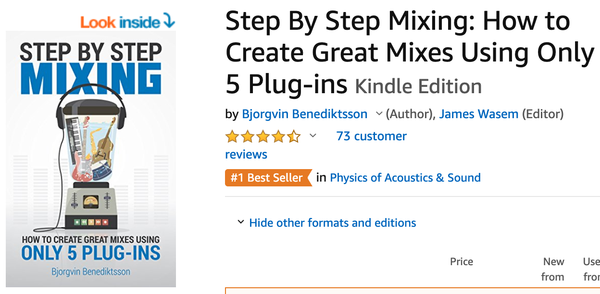
Personally, my mix translation process is as follows, as documented much more extensively inside Step By Step Mixing:
Rough Mix
I mix in mono on my Behringer Behritone Mixcube, mostly following the steps I’ve given you in the previous chapters. The Mixcube is a terrible speaker that has no low-end or highs. It has only one driver and sounds pretty terrible. However, if I can make my mix sound halfway decent on this speaker I know I’m getting somewhere.
Multiple Speaker Check
I flip my mix over to my Yamaha HS-5s and do another round of tweaking. This is usually a rebalancing effort on EQ but I also flip my mix out of mono at this point. Now I can hear the stereo spectrum pretty well. If I get a “whoa! That mix really opens up even though it wasn’t sounding bad before” I know I’m on the right track. I’ll spend some time on reverb, delays and other effects.
Then I listen to my mix on my Focal CMS50s that are coupled with a subwoofer. Now I can really hear all the little things in the mix, as well as all the low-end that’s present. Usually, this requires me to tweak the drums, kick, bass and other low-end instruments.
How My Dog Helps Me Finish My Mixes
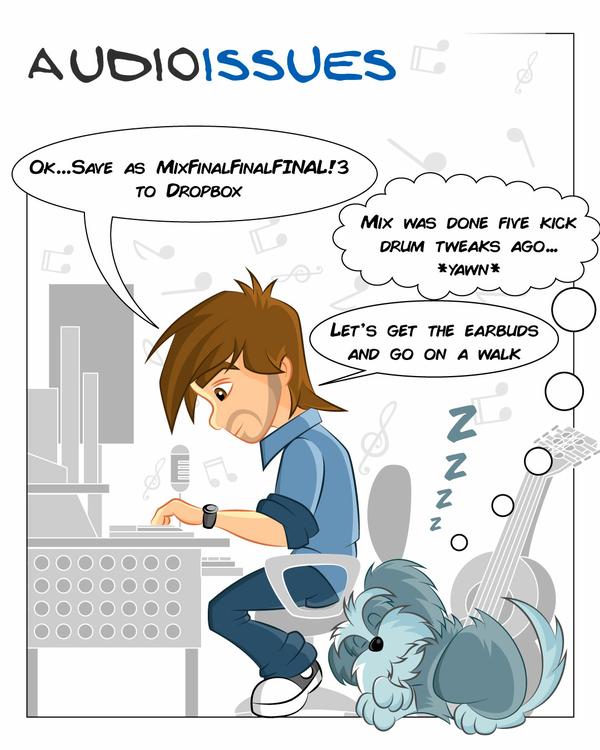
Once I feel my mix is done I bounce it and upload it to Dropbox. I take the dog for a walk and listen to my mix multiple times on earbuds, making mental notes of what needs to be changed.
Honestly, I think my dog Buckley knows my mix workflow better than myself, as portrayed here in the first ever Audio Issues comic strip:
He'll be lying on the rug in the back of the studio as I'm doing my mix checks.